
The scope of services of M&P
- Development and implementation of a heat transformation concept for the Lübeck site
- Focus on sustainable CO₂ reduction
- Assessment of various renewable energy sources
- Preliminary planning of the first stage of transformation
- Gradual and flexible decarbonisation
Germany aims to be climate-neutral by 2045 – a target that is not merely a political statement. It has long been reflected in the strategies of many companies. This commitment is also firmly embedded at Dräger in Lübeck. The family-owned company has commissioned the M&P Energy Team to develop a strategic heat transformation concept for the Lübeck site – as an important step towards a climate-neutral future.

Corporate conviction and active responsibility
Dräger is a global manufacturer of medical and safety technology equipment and systems and can certainly be described as a company driven by conviction when it comes to adopting a sustainable and future-proof approach. This is evident not only in ‘small’ gestures, such as preserving old fruit trees on the factory premises, but above all in large-scale, thoroughly impressive practical actions in the company’s day-to-day operations.
For instance, in recent years Dräger has reduced its gas consumption by 25 per cent of its own accord – solely through comprehensive adjustments to room temperatures, operating hours and the consistent optimisation of various control parameters for technical systems. “Climate action must be cool – we want to make the world a little better!” said Mr Stefan Dräger, Chairman of the Executive Board of Drägerwerk AG & Co. KGaA, in an interview with the Lübecker Nachrichten in February 2025. For him, one thing is certain: it is not a proliferation of regulations and legal micromanagement that drives progress, but rather initiative and a passion for technological innovation.
He sees municipal heat planning as an important milestone on the path to climate neutrality – and as the foundation for the heat transformation of the company’s own sites. This is precisely where M&P’s work comes in.
A concept for a special site
For the headquarters in Lübeck, M&P’s energy team has developed a heat transformation concept that can serve as a blueprint for other industrial companies. The factory site has been in use for over 130 years – an established structure that requires modern technologies to be integrated into buildings, some of which are very old.
Our task: to design and implement a holistic solution that is future-proof and ensures long-term CO₂ reduction.
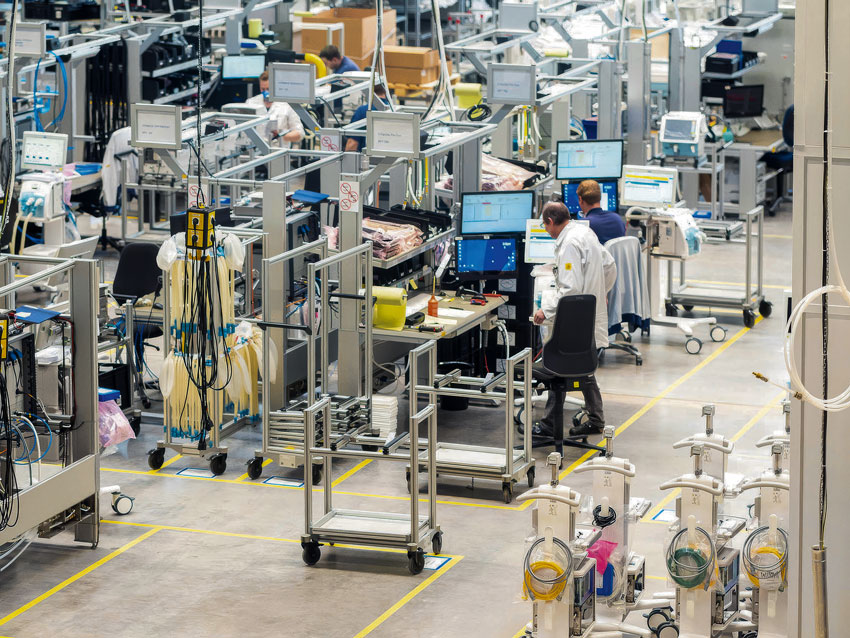
Image: © Patrick Ohligschläger
Starting point: Analysis of the existing heating system
The site is supplied via its own local heating network and a central boiler house, which runs exclusively on natural gas. To reduce emissions, Dräger already shuts down the network completely during the summer.
For the new energy concept, the M&P energy experts examined various energy sources:
- Geothermal energy on the factory site
- Use of the municipal sewage pipeline that runs through the site
- River water (rejected due to low feasibility)
- Air-to-water heat pumps
- District heating to cover peak loads – combined with the integration of existing gas boilers
The aim: to implement the measures in stages over several years so that CO₂ emissions fall continuously and cost-effectiveness is ensured. The use of heat pumps also requires a reduction in the flow temperature on the factory premises. M&P supported a local engineering firm in assessing the building’s thermal performance.
Challenges in the existing building stock – and a clear plan
The analysis made it clear that two large building complexes require very high flow temperatures. Both are ageing, partly let and cannot be refurbished in the short term.
In other areas, however, refurbishments are planned or are already underway. M&P proposes a phased approach:
- The heating network will be split according to the required system temperature.
- Parts of the factory site will be provided with their own district heating connection.
- Older buildings will continue to be supplied 100 % by gas boilers for the time being.
- All remaining buildings will in future be supplied highly efficiently via geothermal energy and waste water heat pumps, using reduced flow temperatures.
This first major step in the transformation is already at the preliminary planning stage.
What’s next? A look to the future
Once the older buildings have been refurbished, the heating network can be reconnected. The plans for then are as follows:
- Installation of air-to-water heat pumps
- Connection of the boiler house to the district heating network
- Use of surplus heat by the municipal utilities to supply a new neighbourhood
- At the same time: Meeting peak loads directly on site
The result: continuous, flexible decarbonisation in several stages. It is not one big step, but many cleverly phased measures that make Dräger’s transformation path economically viable – and energy-efficient.
In parallel with the preliminary planning of the first transformation steps, M&P has been awarded a further contract: our energy experts are now also examining the production site on Revalstraße.
Together with Dräger, M&P is demonstrating how the heat transition can succeed on an industrial scale – step by step, sustainably and with a future-proof approach. Another example illustrates our work for ZF Friedrichshafen AG. Here, we are making various production sites climate-neutral.
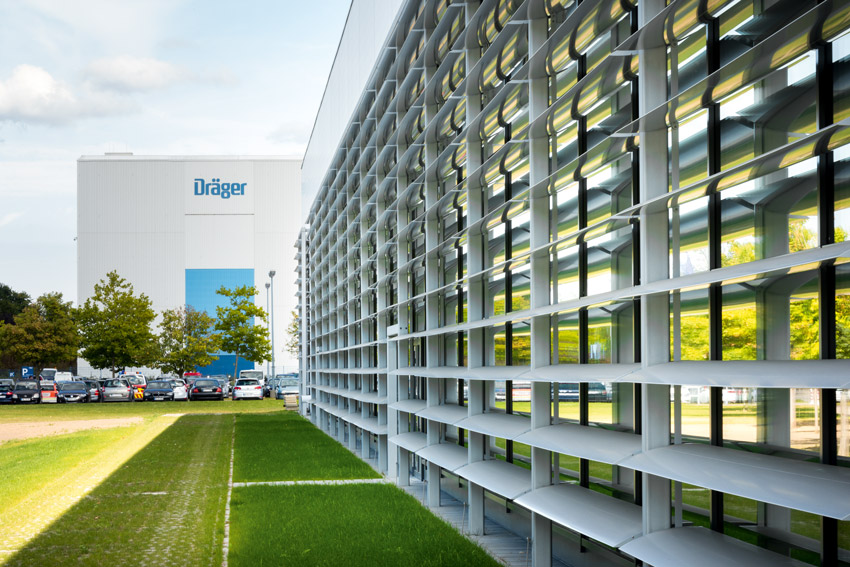
Images: © Drägerwerk AG & Co. KGaA