Proactive rather than reactive
The role of the FM service provider in digitisation.


How our M&P Energy Team achieves measurable positive impact in projects.
Most of us – far beyond our industry – are familiar with the term ‘footprint’. It describes the impact of our lifestyle or a company’s activities on the environment, particularly with regard to CO2 emissions. The average CO2 footprint of a person in Germany is around 10 tonnes per year. Far less well known, however, is the term ‘handprint’. It indicates the extent of the positive impact that a person or a company has on the environment and climate. The handprint highlights what we are actively improving – and offers a consciously optimistic outlook for the future. It is precisely this understanding that forms the central guiding principle behind every M&P solution.
In M&P’s Energy division, the positive handprint is particularly evident: we support industrial sites, property complexes, airports and hospitals in saving energy and intelligently transforming unavoidable energy requirements – with the aim of achieving a CO2-neutral supply.
In every project, it is particularly important to us to counter the often prevailing pessimistic view of climate change with something constructive. Because one thing is clear: much more is already happening than is generally perceived or reported. Good news simply often struggles to be heard as much as bad news does.
The public debate surrounding the so-called Heating Act, for example, falls short from our technical perspective. It distracts from the essentials. In many cases, our clients are already significantly further ahead in their strategic and technological orientation – pragmatic, solution-oriented and forward-looking.
The M&P Energy team demonstrates what is already feasible today when several factors come together: the will to change, technical expertise and solution-focussed competence, long-term thinking, openness to new ideas and entrepreneurial action.
In this way, we support companies in meeting ESG requirements and in introducing and further developing energy management systems in accordance with the international standard ISO 50001 – in a holistic, practical and effective manner.
For Drägerwerk AG & Co. KGaA, our energy team developed a holistic heat transformation concept that ensures the heat supply at the headquarters in Lübeck is fit for the future – despite the partly historic building structures – and enables a sustainable reduction in CO2 emissions.
At ZF Friedrichshafen AG (ZF), our experts analyse heat generation in energy-intensive production processes – such as in melting and hardening furnaces. On this basis, they develop tailor-made alternatives and pave the way towards CO2-neutral operations.
Internationally active companies also benefit from our expertise: worldwide, our team identifies energy-saving potential and optimises production sites.
And last but not least, we are effectively and sustainably driving forward energy transition projects in the property sector – through the combination of data-driven energy analysis and the practical implementation of technical measures in existing buildings.
Good news. And this is just the beginning.
The examples mentioned above are representative of more than 30 major projects that we have implemented over the past year. In 2025 alone, this will result in a measurable, positive ‘handprint’ of 65,000 tonnes of CO2 saved.
That’s certainly encouraging!
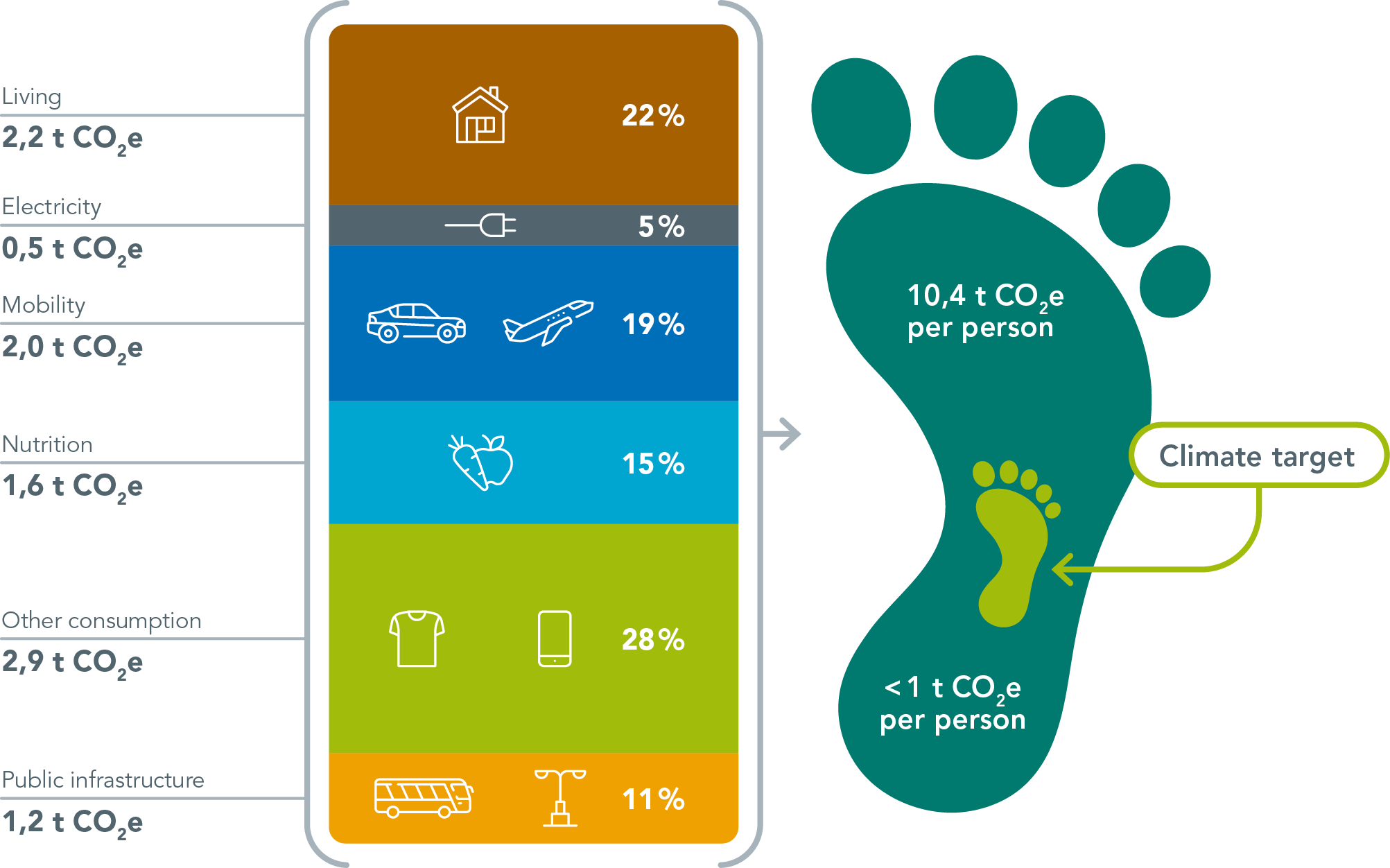
Average CO2 footprint per capita in Germany
CO2e: The effects of different greenhouse gases (e.g. methane) are converted into CO2 equivalents and included in the calculation.
Source: Federal Environment Agency CO2 calculator (as at 2025)

