
Sprichst du schon mit deinem Gebäude?
BIM@FM trifft AI oder: wie M&P BEGIS künstliche Intelligenz im Sinne von BIM im Betrieb für Gebäude nutzt.


M&P is shifting its focus – from the question of tools to data-driven value creation.
The operational phase of a property is the central anchor point for all operational processes within the building. Whilst sustainability officers are still debating strategies and frameworks, crucial information has long been emerging right where buildings are operated on a daily basis. This is precisely where M&P comes in.
Despite adjustments to the CSRD and CSDDD, the pressure shows no sign of easing. Banks, investors and stakeholders are demanding robust sustainability metrics. A study by the Haufe Group shows that 60 to 80 per cent of the required data is already available within building operations – on paper, in Excel spreadsheets, in operational reports or in the minds of experienced staff. However, the industry still treats ESG primarily as a question of tools. Yet the answers lie in processes that, through digitalisation, serve as a lever for data sovereignty, efficiency and reporting.
Companies begin their ESG journey by searching for the ‘right tool’. This often leads to a dead end. Even the best software is only as good as the data it uses. Reporting projects rarely fail because of frameworks, but rather due to data acquisition, quality and availability. M&P turns this perspective on its head: we do not view ESG as an additional obligation, but as a catalyst for a long-overdue digitalisation of operations. This brings a twofold benefit: digitalised processes do not merely generate ESG data ‘as a by-product’. They also deliver efficiency gains, transparency and a better basis for decision-making.
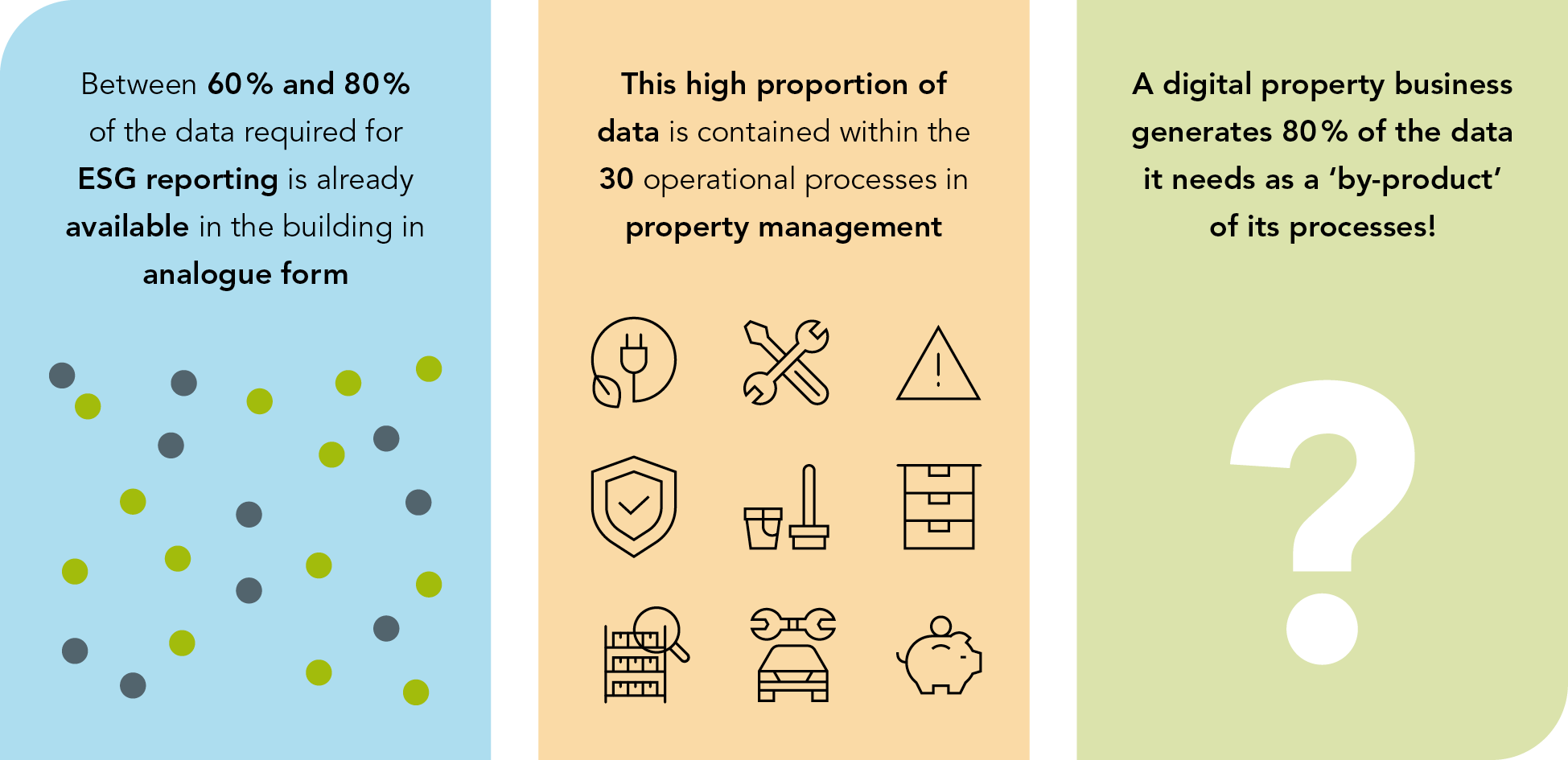
Figure: Realising added value from the digitalisation of analogue processes and obtaining ESG data as a ‘by-product’
Thesis 1 – Dual benefits: Digitised operational processes deliver ESG data as a ‘by-product’. Digitisation already pays for itself through operational efficiency gains.
Thesis 2 – Not yet a reality: For many, fully digital property management remains a project for the future. Without structured digital processes, valid ESG reporting will be virtually impossible.
Thesis 3 – The data issue remains central: those who establish data sovereignty in their operational activities position themselves as indispensable partners for sustainability strategy.
The path to data sovereignty: an honest assessment of existing data sources, standardisation using tried-and-tested models (GEFMA, DIN 276), and structured data collection based on the principle of ‘keep it simple and clean’.
The AQVA principle is crucial: timeliness through regular data collection, quality through plausibility checks, availability through clear responsibilities, and aggregation for meaningful key performance indicators. An example: A piece of equipment reports a fault. The service technician travels to the facility, repairs it and disposes of defective components in accordance with best practice. This routine process automatically generates data across all ESG scopes: electricity consumption, fuel consumption, waste disposal.
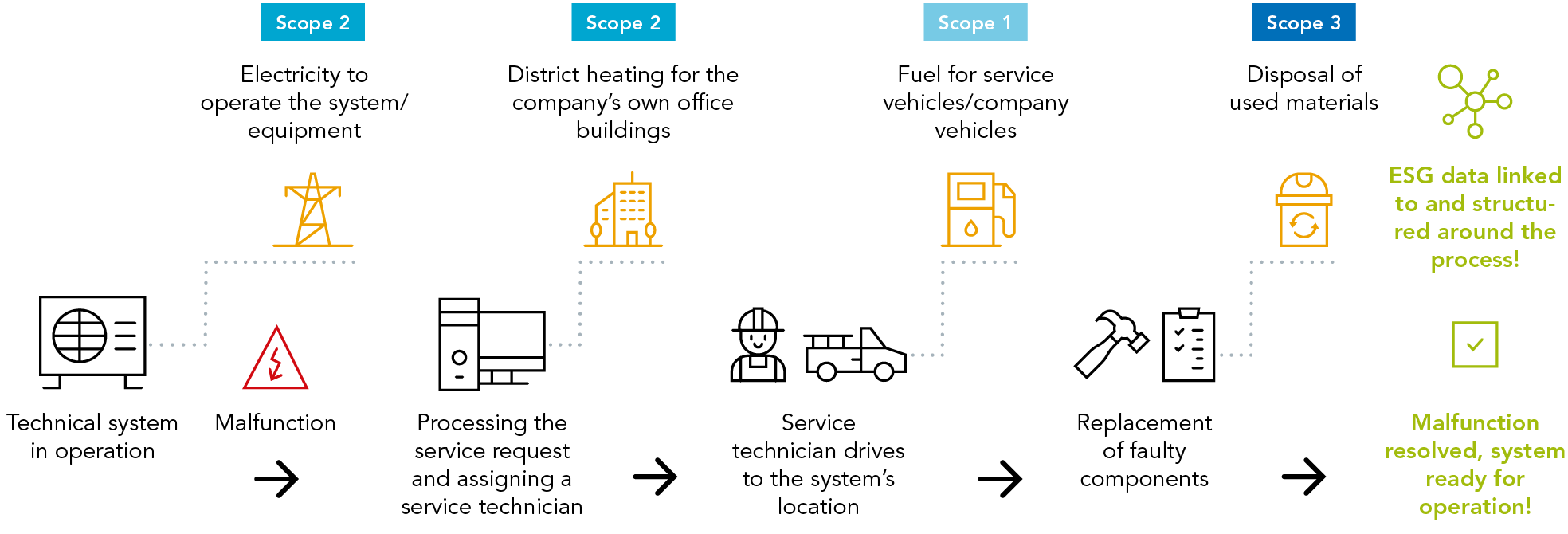
Scalability makes all the difference: one fault yields four data points; twenty faults yield 80; ten buildings yield 800. Further digitised processes such as maintenance, cleaning or fleet management increase the data pool exponentially – without any additional data collection effort.
The digital twin is the pinnacle: a dynamic building model that integrates real-time data, enables predictive analytics and transforms FM from a reactive observer into an active shaper.
Conclusion: Key Takeaways
BIM@FM trifft AI oder: wie M&P BEGIS künstliche Intelligenz im Sinne von BIM im Betrieb für Gebäude nutzt.

The role of the FM service provider in digitisation.

How our M&P Energy Team achieves measurable positive impact in projects.